
Flexibility needs clear interfaces
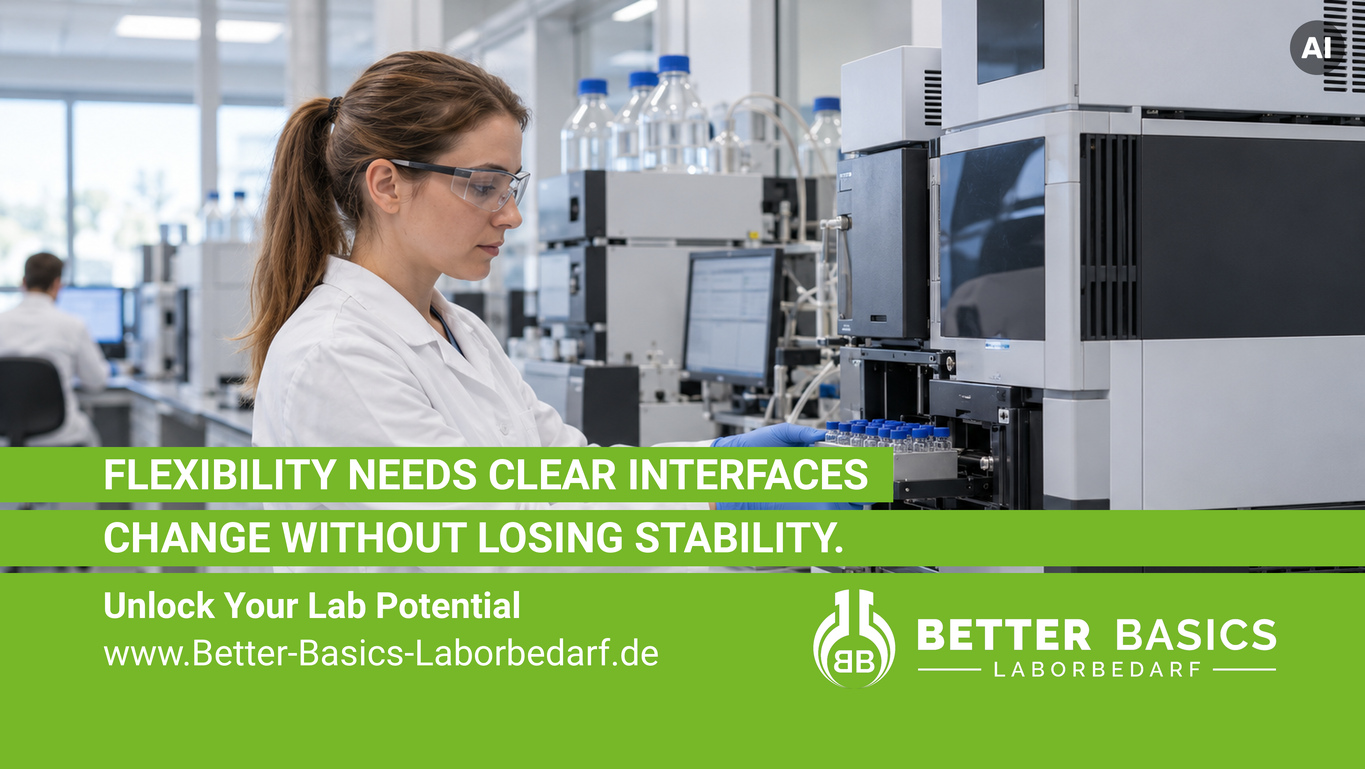
Laboratory work needs to respond to changing sample volumes, priorities and methods. Flexibility does not mean suspending standards whenever demand changes. It emerges when people know what may change, what must remain stable and how the interface between the two is controlled.
The white paper “Lean Labor – Die Architektur guter Arbeit” puts it this way (editorial translation from German): “Flexibility does not begin where order ends. It begins where clear interfaces allow change without the whole system losing stability.”
A clear interface describes more than a physical connection. It also defines prerequisites, responsibility, permitted variants, approval and the return to a defined state. This makes a change traceable without requiring adjacent process steps to be reorganised every time.
One possible example from analytical quality control is changing a prepared sample carrier at a defined transfer position. Before the change, sample identity, method status, compatibility, cleanliness and availability are checked. The new series is introduced in a controlled manner while the basic workstation configuration and procedural requirements remain unchanged.
5S can make such interfaces visible: defined docking points, clearly assigned change parts and fixed preparation positions can support orientation. Visible order alone does not, however, constitute technical approval and does not replace qualification or change control.
Not every change is reversible or can be controlled locally. Changes to validated methods, qualified equipment, data flows or safety-relevant conditions require the applicable review, approval and documentation routes. The appropriate interface therefore depends on the risk and context.
Review one recurring change in the laboratory: are the permitted variants, transfer point, responsibility and return to a safe initial state clearly defined?